
Reviewed · FORBIDDEN CITY & TIANANMEN SQUARE TOURS
Beijing:Forbidden City–Reveal Secrets Behind Red Walls
This tour turns palace walls into clues. I like the way Coco and Molly mix clear explanations with hands-on observation, so you’re not just staring at names on plaques. Two big pluses for me: the interactive game-style learning (you look, you guess, then you get the full answer) and the memory support—edited photos and even a tour video recording approach you can use to relive the day.
One thing to weigh: the Forbidden City is security-heavy, and entry checks can add time beyond the main ticket line. Add peak-season crowds and you’ll want to build a little buffer into your plans.
In This Review
- Choose your style: Decoder, Private, or Ticket-Only
- Key things you should know before you go
- Four hours on the central axis: why this route works
- Picking A, B, or C: what each package changes
- Option A: Forbidden City Decoder (small group)
- Option B: Forbidden City Decoder (private tour)
- Option C: Ticket Only
- Step-by-step route: what you’ll learn at each landmark
- 1) Meeting area: 午门, Donghuamen Street, or 东华门 (and then Donghua Gate)
- 2) Meridian Gate (about 30 minutes)
- 3) Gate of Supreme Harmony (about 15 minutes)
- 4) Hall of Supreme Harmony (about 40 minutes)
- 5) Hall of Central Harmony (about 10 minutes) + Hall of Preserving Harmony (about 20 minutes)
- 6) Break and photo stop (about 15 minutes)
- 7) Palace of Heavenly Purity (about 40 minutes)
- 8) Hall of Union (about 10 minutes)
- 9) Palace of Earthly Tranquility (about 20 minutes) + long break with tea, dessert, and tasting (about 1 hour)
- 10) Imperial Garden (about 15 minutes) + photo/free time (about 10 minutes)
- 11) Gate of Divine Prowess (about 10 minutes) and finish near 神武门
- The interactive learning: how Molly and Coco change the experience
- Price and value: why $10 can still feel like more
- Logistics that actually affect your day (passport, security, weather)
- Who should book this Forbidden City experience
- Should you book? My practical take
- Quick FAQ
- FAQ
- What does the tour price include?
- Is tea and dessert included during the tour?
- Do I need an illustrated handbook?
- Where do I meet for the tour?
- What time does the Forbidden City Decoder tour start?
- What should I bring for entry?
- Are there any restrictions on who can join?
Choose your style: Decoder, Private, or Ticket-Only

You’re basically picking how much guidance you want over a walk along the palace’s main spine. If you choose the Decoder options, you’ll use an illustrated handbook and follow a guided route that focuses on imperial meaning—architecture, philosophy (Yin-Yang and five elements ideas), and a broad timeline from 1420 to 1912. If you choose Ticket Only, you get the entry ticket but not the storyteller, so you’re on your own for the meaning.
Back through the red gates, more Forbidden City walks
Key things you should know before you go
- Game-based learning, not lecture mode: you observe details, then the guide connects them to the bigger story.
- Coco handles the memories: photos are edited for you, with the option of a filmed tour-style recap.
- Molly anchors the history and answers questions: you can go deeper without the tour shutting down.
- Yin-Yang and five-elements are used as a lens: you’ll see buildings and layout as purposeful symbols, not random scenery.
- One long rest point with tea and tasting: you get a real break instead of rushing straight through.
Four hours on the central axis: why this route works
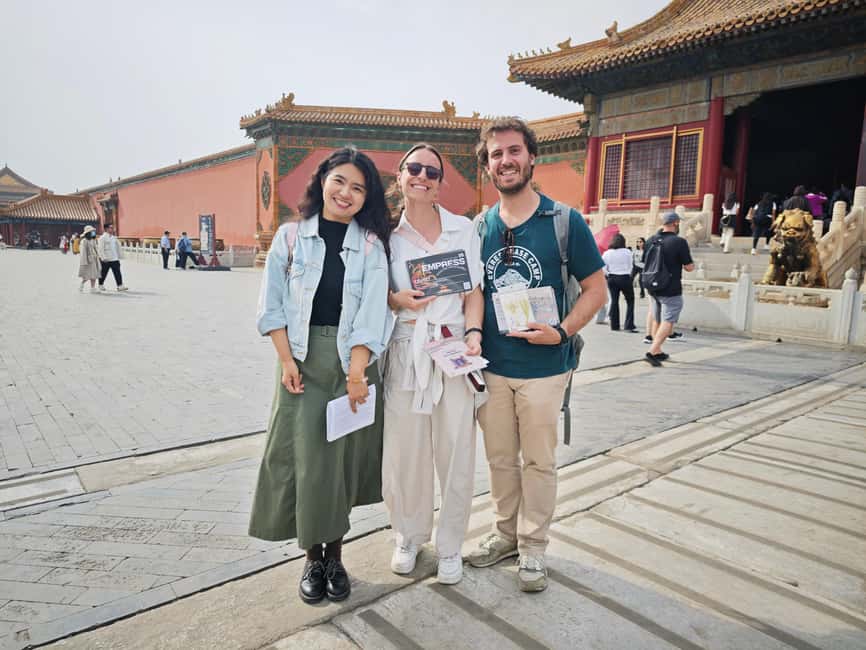
The Forbidden City is huge, and “seeing everything” is a trap. This experience is designed around focus: you follow the central axis and hit the main ceremonial and power spaces. That matters because the palace’s layout is part of the message. When you walk the spine in order, the symbolism makes more sense—gate to hall, hall to palace, public authority to inner rule.
You also get a rhythm that keeps your brain awake. There are guided segments (where you learn what to notice), plus short photo/free windows (where you actually look and apply what you just heard). The result is that you leave with mental hooks—specific places tied to specific ideas—rather than a blur of red walls and yellow roofs.
And yes, the setting is unmistakably dramatic. But what I like is that the tour doesn’t treat the drama as the whole point. It helps you read it.
Picking A, B, or C: what each package changes
This activity gives you three ways in, depending on how you want to experience the Forbidden City.
Option A: Forbidden City Decoder (small group)
This is the sweet spot if you like structured learning but still want energy. You meet at Donghua Gate with start times at 8:30 or 12:30, and the tour runs about 3.5–4 hours. You’ll use an illustrated handbook during the trip. Expect a route packed with iconic stops along the central axis, plus interactive moments that feel like a self-guided puzzle with guided explanations.
The wider sweep of Beijing in one go
- Beijing Full Day Tours: Tiananmen Sq, Forbidden City, Great Wall★ 5.0 · 1,634 reviews
- Beijing: Tianmen Square, Forbidden City & Royal Museum Tours★ 4.6 · 1,288 reviews
- Beijing Forbidden City Ticket Booking (Optional: guide service)★ 5.0 · 1,263 reviews
- Beijing: Forbidden City and Tian’anmen Square Waking Tour★ 4.9 · 1,002 reviews
- Forbidden City&T-Square Small GroupTours w/ ticket(Eng/Esp Guide)★ 5.0 · 995 reviews
Option B: Forbidden City Decoder (private tour)
If you want more flexibility, Option B lets you tailor the route and timing. It’s still based around the same overall central-axis focus and meeting at Donghua Gate at 8:30 or 12:30, but you get customized routes and itinerary arrangements support. This works well if you have specific interests—architecture symbolism, ceremonies, or deeper Q&A.
Option C: Ticket Only
Only pick this if you already plan to navigate with your own notes and guidebook. Option C includes Forbidden City entry but not the attraction storyteller. You won’t have the interactive learning or the illustrated handbook experience, so you’re relying on your own ability to connect what you see to the meaning.
Step-by-step route: what you’ll learn at each landmark
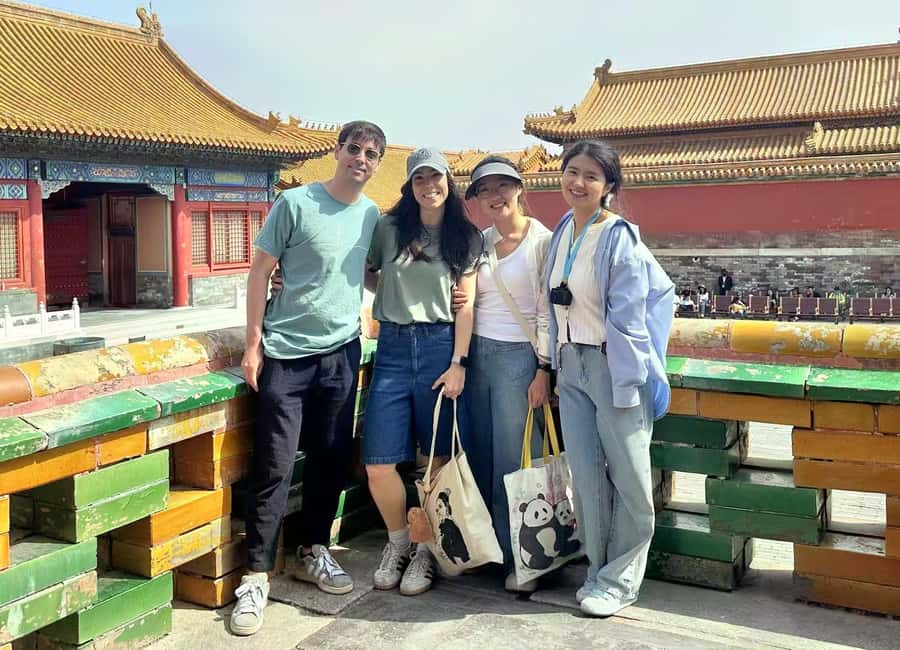
Below is the flow you’ll follow. Times can shift slightly with your group and pace, but the order is the backbone of the experience.
1) Meeting area: 午门, Donghuamen Street, or 东华门 (and then Donghua Gate)
Depending on the option, your meeting point may be one of these spots: 午门, Donghuamen Street, or 东华门. For the Decoder packages, you’ll connect around Donghua Gate. The practical benefit: you’re not spending your first hour hunting for the right entrance while everyone else is already moving.
Tip: come with your passport/ID ready. The day starts with checks, and slowing down at the start creates delays later.
2) Meridian Gate (about 30 minutes)
Meridian Gate is where you start to understand the palace as a system: authority, access, and hierarchy. In this experience, the guide won’t only name what you’re looking at. They point out how the space signals power and control—why certain views are framed and why movement is choreographed.
This is also a good moment to tune your eyes to symmetry and placement, because that theme repeats all the way through.
3) Gate of Supreme Harmony (about 15 minutes)
This gate works like a title page. The guide uses it to set expectations: this is the area where ceremonial rule is displayed. The takeaway isn’t just history—it’s how imperial meaning gets built into design.
If you like symbolism, this stop is a good “reset” before the big halls.
4) Hall of Supreme Harmony (about 40 minutes)
This is one of your anchor stops. Expect more time here because it’s central to the story of sovereignty and ceremony. The guide focuses on what the building communicates—imperial authority shown through form and arrangement—then ties it to the tour’s bigger framework.
The plus: you’ll understand why the details matter, even if you’re not an architecture specialist. The trade-off: it can feel like a lot to take in, so use the nearby photo/free window to breathe and absorb.
5) Hall of Central Harmony (about 10 minutes) + Hall of Preserving Harmony (about 20 minutes)
These halls keep the pace moving. Central Harmony and Preserving Harmony offer contrast in function and symbolism. In practice, the short timing here helps you avoid the common problem of overstaying in one hall and getting bored by the time you reach the inner palaces.
6) Break and photo stop (about 15 minutes)
Use this window. Even with a guide, your feet will be working. This break is also where you can look around and notice alignment and sightlines while your brain is fresh.
7) Palace of Heavenly Purity (about 40 minutes)
Now you shift from the ceremonial public face toward the inner world of rule. This stop is where the philosophical lens—Yin-Yang balance and five-elements theory ideas—comes into play. The guide connects these concepts to the way meaning is embedded in the palace environment.
If you’ve ever wondered why Chinese imperial design feels so intentional, this is the moment you start answering that for yourself.
8) Hall of Union (about 10 minutes)
A quick but useful connector stop. The guide uses it to keep the narrative moving: you’re not just wandering from one highlight to the next. Think of this as a bridge between the major “inner” spaces.
9) Palace of Earthly Tranquility (about 20 minutes) + long break with tea, dessert, and tasting (about 1 hour)
This is the stop with the real recovery value. You get another guided segment, then a longer break that includes tea, dessert, a tea ceremony moment, and food tasting.
Why this matters: Forbidden City walking wears you down. A structured rest here helps you enjoy the garden section after, rather than feeling “done” halfway through.
10) Imperial Garden (about 15 minutes) + photo/free time (about 10 minutes)
The garden provides a softer look after the heavy ceremonial and inner-palace spaces. The guide keeps it focused, so it’s not just a stroll—you’ll know what to look for and why it sits where it does.
Use the free time for photos from different angles. With the earlier teaching, your photos start capturing meaning, not just scenery.
11) Gate of Divine Prowess (about 10 minutes) and finish near 神武门
This final stop gives the walk a clean ending point. You finish at 神武门. Practically, that helps if you’re heading onward afterward without guessing where the “last” exit should be.
The interactive learning: how Molly and Coco change the experience
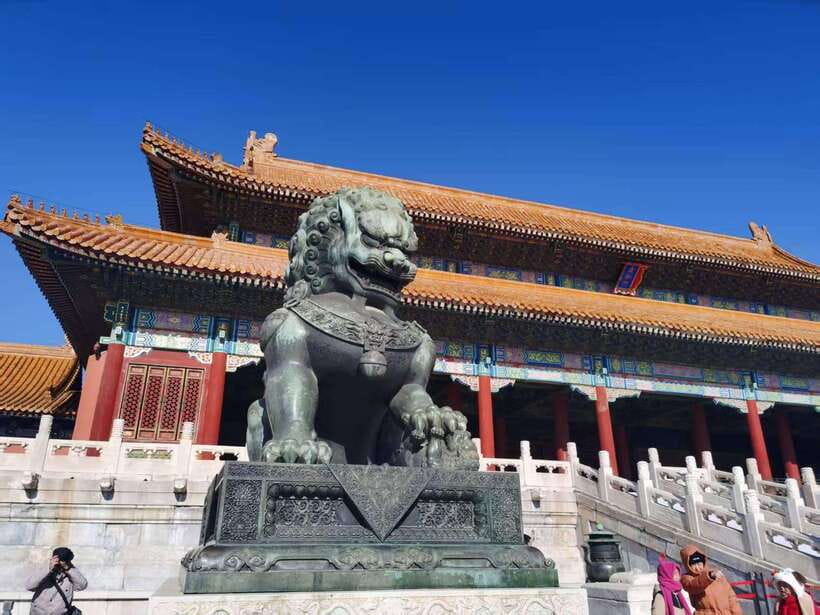
The biggest reason this tour works is how the guides run it.
Molly is the history and Q&A engine. In my notes from what you’ll experience here, she answers questions at a natural pace and uses the tour format to help you connect clues to explanations. The interactive element is designed so you’re not memorizing facts. You’re building deductions as you walk—then getting the richer answer afterward.
Coco is focused on the photo and video side. You get edited photos as part of the included package, and there’s an added layer to the memory capture: the guide has used a tour-recording approach (body-cam style) to generate a full video of the visit. Even if you’re not chasing social media, it’s a nice way to remember the day beyond your own phone shots.
Together, they cover both “what am I looking at?” and “how do I keep the memories?”
Price and value: why $10 can still feel like more
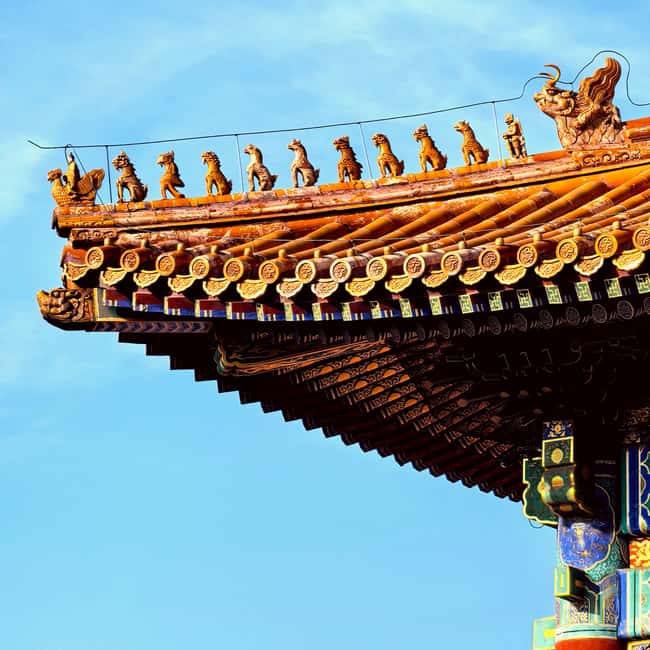
At $10 per person, the best value piece isn’t the ticket. It’s what you’re getting with the ticket: a guide in English and Chinese, entry to the Forbidden City, plus edited photos (and the tour-memory video approach).
What’s not included is also clear: you’ll pay for drinks and snacks, and the clock and jewelry museum entry ticket isn’t included. If you’re the type who wants to add museum stops inside the complex, you’ll need to budget extra time and money.
So the value question becomes: do you want help reading the palace, or do you just want to wander? If you like structure and explanation, the low price makes sense because the storyteller is doing the heavy lifting. If you only want entry access, Ticket Only (Option C) may be better.
Logistics that actually affect your day (passport, security, weather)
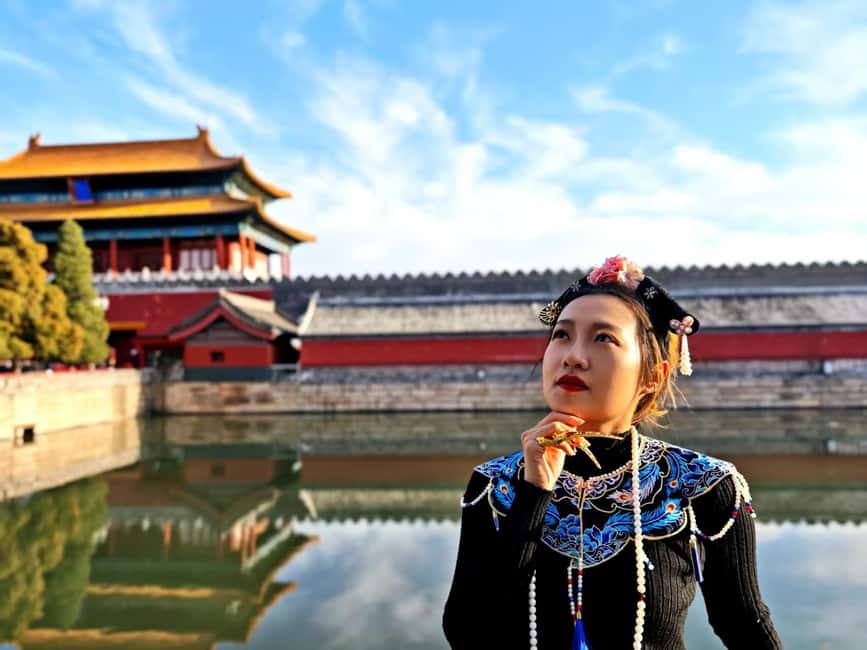
This is the part people underestimate, so I’ll say it plainly.
Bring your passport or ID card—passport is required for sights entry. Plan for mandatory security checks at site entry points. The waiting time can be high during peak times/seasons and it’s separate from the main ticket line. That can turn your “I’ll arrive late and still be fine” plan into “I’m standing in a queue with everyone else.”
Weather matters too, but not as a total dealbreaker. Tours generally run in rainy or snowy days unless heavy conditions trigger government closures.
And a few practical rules: no weapons or sharp objects, and no pets (assistance dogs are allowed). If you’re traveling with a lot of small gear (umbrella tips, sharp tools, etc.), check your bag before you go so you’re not forced into last-minute sorting.
Who should book this Forbidden City experience
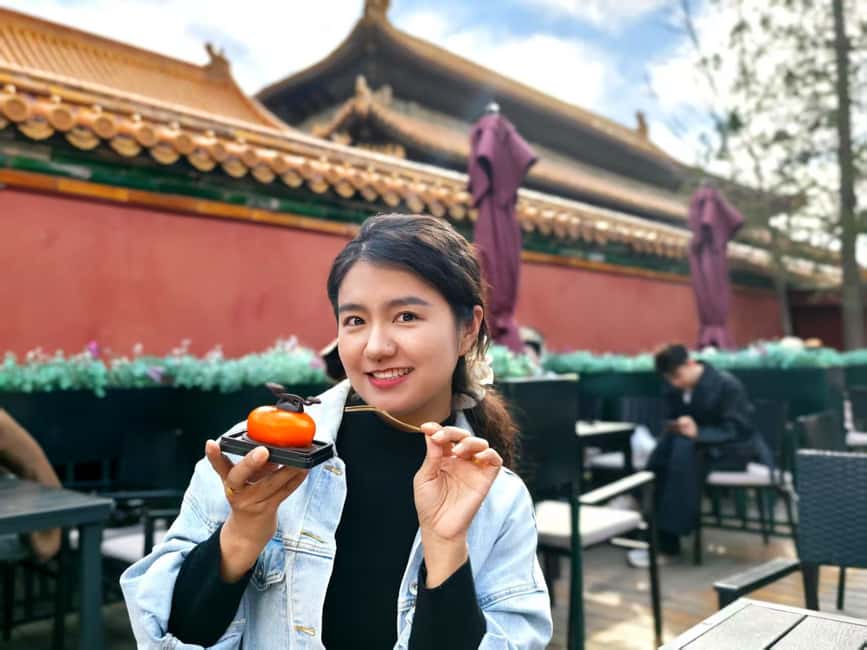
This one fits best if you want three things at once:
- You care about meaning (not just photos)
- You enjoy interactive learning—finding clues, making deductions, and then getting the full explanation
- You want your day to include a real rest point (tea, dessert, tasting) instead of constant walking
It’s especially a good match for couples and small groups because the tour format is built around manageable size. It’s also handy if you don’t speak Chinese, since the guide runs in English and Chinese.
It’s not a good fit for wheelchair users, and it’s not suitable for people over 95.
Should you book? My practical take
If your plan is to see the Forbidden City but you’re worried you’ll forget what you saw by the end of the day, book this. The interactive structure, plus the Coco and Molly balance of history and memory capture, turns a massive site into a sequence you can remember.
If you prefer totally independent wandering and you already know the palace well (or you’re using your own strong guidebook strategy), Option C could work. But if you want the palace to make sense as you walk, the Decoder format is the better bet.
Quick FAQ
FAQ

What does the tour price include?
It includes entry to the Forbidden City, an English/Chinese-speaking guide, and edited photos. The longer memory side can include tour-video style capture as well.
Is tea and dessert included during the tour?
Yes. There’s a scheduled break at the Palace of Earthly Tranquility with tea, dessert, tea ceremony, and food tasting.
Do I need an illustrated handbook?
For Option A and Option B (the Decoder tours), the illustrated handbook is needed during the trip. Option C (Ticket Only) does not include the attraction storyteller.
Where do I meet for the tour?
Meeting points can vary by option. You may meet at 午门, Donghuamen Street, or 东华门. The Decoder tours specifically meet around Donghua Gate.
What time does the Forbidden City Decoder tour start?
For the Decoder options, start times are 8:30 or 12:30.
What should I bring for entry?
Bring your passport or ID card, since it’s required for entry.
Are there any restrictions on who can join?
The tour is not suitable for wheelchair users and not suitable for people over 95 years.
The Capital, Corner to Corner
- Beijing: Forbidden City Tour(Group/Private)-Tickets Included
★ 4.8 · 7,974 reviews - Beijing: T-Square & Forbidden City Group or Private Tour
★ 4.8 · 4,446 reviews - All-Inclusive Tour: Tiananmen Square, Forbidden City, Great Wall
★ 5.0 · 2,873 reviews - 4-Hour Small Group Tour to Forbidden City with Entry Tickets
★ 5.0 · 1,863 reviews - Beijing Full Day Tours: Tiananmen Sq, Forbidden City, Great Wall
★ 5.0 · 1,634 reviews - Beijing: Tianmen Square, Forbidden City & Royal Museum Tours
★ 4.6 · 1,288 reviews
More Tour Reviews in Beijing
- From Beijing: Mutianyu Great Wall Tours with Options
★ 4.9 · 9,216 reviews - Beijing: Forbidden City Tour(Group/Private)-Tickets Included
★ 4.8 · 7,974 reviews - Beijing: T-Square & Forbidden City Group or Private Tour
★ 4.8 · 4,446 reviews - All-Inclusive Tour: Tiananmen Square, Forbidden City, Great Wall
★ 5.0 · 2,873 reviews - MuBus: Mutianyu Great Wall ENG/ESP/RUS Guided Bus Tour
★ 5.0 · 2,361 reviews - 4-Hour Small Group Tour to Forbidden City with Entry Tickets
★ 5.0 · 1,863 reviews
More Time Inside the Forbidden City
- Beijing: Forbidden City Tour(Group/Private)-Tickets Included
★ 4.8 · 7,974 reviews - Beijing: T-Square & Forbidden City Group or Private Tour
★ 4.8 · 4,446 reviews - All-Inclusive Tour: Tiananmen Square, Forbidden City, Great Wall
★ 5.0 · 2,873 reviews - 4-Hour Small Group Tour to Forbidden City with Entry Tickets
★ 5.0 · 1,863 reviews - Beijing: Tiananmen Square Registration Service(Ticket)
★ 4.5 · 1,704 reviews - Beijing Full Day Tours: Tiananmen Sq, Forbidden City, Great Wall
★ 5.0 · 1,634 reviews
Just In: More Beijing Tours to Browse



Forbidden City & Tiananmen Square Tours, compared.
 ★ 4.8Forbidden City Tour(Group/Private)-Tickets IncludedFrom $47,974 reviews
 ★ 4.8T-Square & Forbidden City Group or Private TourFrom $174,446 reviews
 ★ 5.0All-Inclusive Tour: Tiananmen Square, Forbidden City, Great WallFrom $1282,873 reviews
 ★ 5.04-Hour Small Group Tour to Forbidden City with Entry TicketsFrom $151,863 reviews
 ★ 4.5Tiananmen Square Registration Service(Ticket)From $31,704 reviews
 ★ 5.0Beijing Full Day Tours: Tiananmen Sq, Forbidden City, Great WallFrom $991,634 reviews
 ★ 4.6Tianmen Square, Forbidden City & Royal Museum ToursFrom $41,288 reviews
 ★ 5.0Beijing Forbidden City Ticket Booking (Optional: guide service)From $91,263 reviews
Browse the lists this tour appears in